
The website management total cost nobody budgets for
Start with a published wage, then add what payroll adds. The US Bureau of Labor Statistics(opens in a new tab) puts the median annual wage for web developers at $92,650 in May 2025. Across private industry, benefits were 30.0 percent of employer compensation cost(opens in a new tab) in June 2026. Recruiting, equipment and manager time come on top of both.
Our arithmetic gives the implied total: $92,650 divided by 0.70. That 70/30 split is an average across all private industry, not a figure for developers, so replace it with your payroll's own. It also leaves out recruiting, equipment and the manager time one more person takes.
In our experience turnover adds to the cost. People who grow in the role often move on, and the recruiting cycle starts again. Each departure takes credentials and undocumented knowledge with it.
| Line | Figure |
|---|---|
| Median web developer wage (BLS, May 2025) | $92,650 a year |
| Wages as a share of employer cost (BLS, private industry, June 2026) | 70.0% |
| Total compensation implied by those two | About $132,000 a year, our arithmetic |
| Twelve months of our retainer tiers | $1,164 to $5,964 |
Run the numbers for your own team
Use your payroll figure, not the advertised salary. Take the loaded cost of one developer, add recruiting, equipment and the manager time spent on them, then divide by the share of the year they spend on the site. Compare that with a year of a retainer, plus scoped project work for anything new.
Take your payroll cost for one developer
Add recruiting, equipment and manager time
Divide by the share of the year spent on this site
Compare with a year of a retainer plus scoped projects
Key-person risk
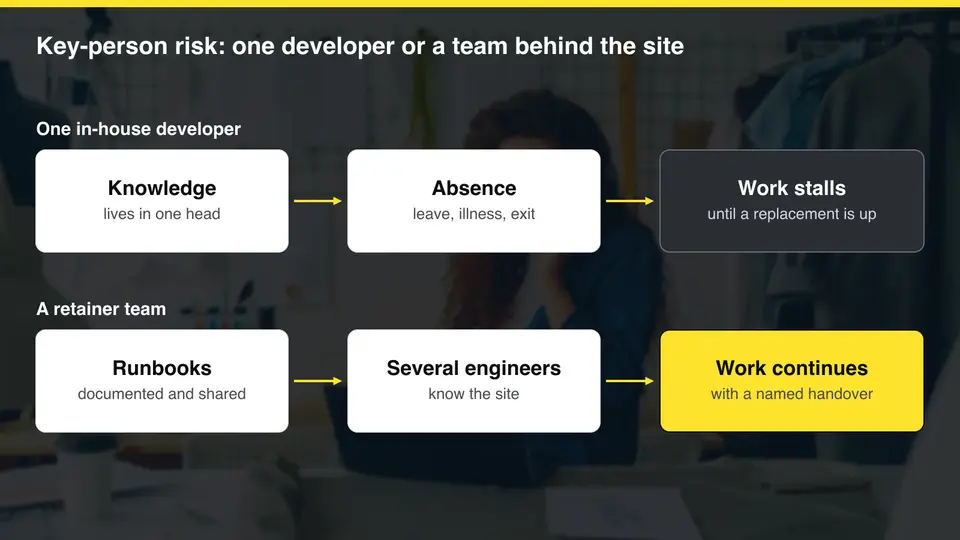
When one person holds the hosting login, the database access and the context for every change, their vacation becomes your exposure window. The risk is not that they are careless. It is that nobody else can act while they are away.
Managed teams spread that knowledge, and our Essential tier includes handover documentation if you leave. Ask any provider where the credentials and the change history live.
- Hosting and DNS logins held by one account.
- Database and deploy access on one laptop or one key.
- Two-factor codes on one phone.
- Changes recorded nowhere but in one person's head.
Hire a web developer or agency: what a retainer buys
Our tiers run from $97 to $497 a month, which is $1,164 to $5,964 over a year. They buy process: verified updates, backups, uptime monitoring and a response commitment. It does not buy a full-time feature developer, and same-week minor edits are not same-day sprints.
Businesses that expect a feature developer get disappointed in both directions, so start by naming the job you are hiring for. The website management service lists what each tier covers.
For what each tier costs and how to price downtime, see how much to pay for website maintenance.

When in-house is the right call
In-house work wins when the website is the product: daily feature work, a product roadmap, and engineers who need the codebase every day. In that case a dedicated hire or a contract developer is the better fit, and the table shows which option suits which job.
In our experience many smaller businesses end up with a hybrid. Retainers keep the site running, and scoped projects handle new features. That split avoids paying a full-time salary for maintenance work, so run the numbers above before you decide.
| Option | Fits when |
|---|---|
| In-house developer | The site is the product: daily feature work and a roadmap |
| Contract developer | Bursts of feature work without a permanent hire |
| Retainer | The site must stay up, patched and backed up, with small edits |
| Hybrid | A retainer keeps the site running and scoped projects add features |
Questions about in-house vs outsourced website management
Is in-house website management cheaper than outsourcing?
Compare loaded cost, not salary. Median pay for a web developer is $92,650 a year, and benefits add about 30 percent of employer cost on average. Twelve months of our retainer cost $1,164 to $5,964, but the two buy different things, because a retainer is not a feature developer.
How much does it cost to hire a web developer?
BLS reports a median annual wage of $92,650 for web developers in May 2025. Benefits, recruiting, equipment and management time are extra, and local pay varies.
Can I use both in-house and outsourced management?
Yes. Use a retainer to keep the site updated, backed up and monitored, while your developer or a scoped project handles new features.